




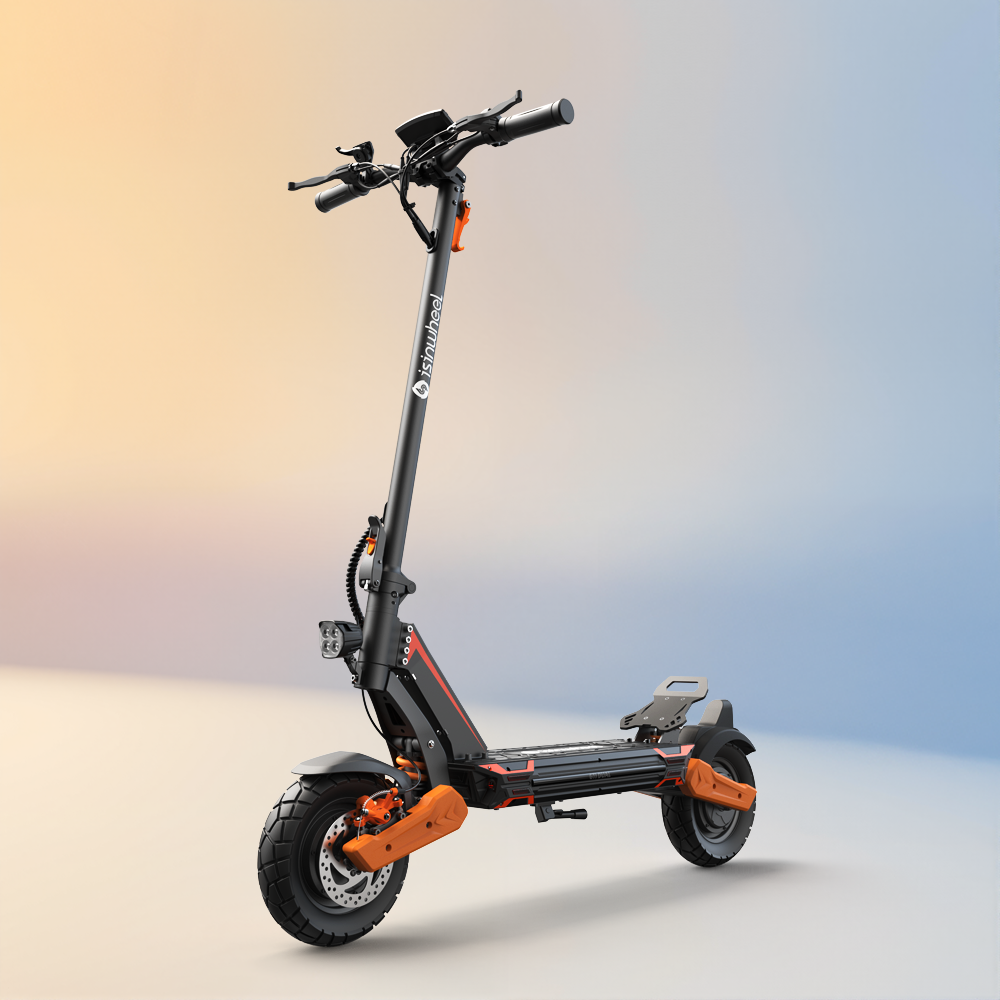
Why should you choose the GT1 Dual motor?
Is your route demanding enough to justify a GT1 dual motor scooter?

A lot of riders do not realize they have outgrown a basic scooter until the same problems show up on the same route. Hills slow the climb, rough pavement beats up your hands and knees, and short bursts into traffic feel weaker than they should. That is the real decision point behind the GT1 dual motor question. You are not only choosing a faster machine. You are deciding whether your daily ride needs more torque, more traction, and more comfort than a simple commuter setup can give.
The GT1 Dual Motor Electric Scooter is built around that upgrade path. iSinwheel lists dual 800W motors, a 48V 13Ah battery, up to 32 MPH top speed, up to 35 miles of range, and climbing ability up to 35%. It also adds 10-inch off-road pneumatic tires, dual swing arm suspension with 45 mm travel, EABS plus disc braking, turn signals, and a 330 lb max load. In other words, this dual motor electric scooter makes the most sense when your route asks for more than flat-ground convenience.
What riding problems the GT1 dual motor actually solves
If you are comparing a single vs dual motor scooter, focus on daily friction instead of headline speed. The GT1 is strongest when your real ride includes:
- repeated hill starts
- uneven asphalt or broken pavement
- dirt paths, gravel connectors, or park access roads
- heavier rider weight or a backpack load
- longer commutes where comfort matters after mile five
- night riding where lighting and visibility matter
That matters because a dual motor scooter for beginners is not automatically the right pick for everyone. If your route is flat, short, and easy to store, extra weight may not pay you back. But if your scooter currently feels sluggish on grades or harsh over cracks, the GT1 solves a real problem rather than adding spec-sheet drama.
Quick snapshot of the GT1 Dual Motor
Here are the specs that matter most in this buyer decision:
- Motor setup: dual 800W motors
- Battery: 48V 13Ah, listed as 624Wh
- Top speed: up to 32 MPH
- Range: up to 35 miles
- Hill claim: up to 35% incline
- Tires: 10-inch off-road pneumatic tires
- Suspension: front and rear dual swing arm, 45 mm travel
- Brakes: EABS brake plus disc brake system
- Load limit: 330 lbs
- Scooter weight: 73 lbs
- Water resistance: IPX4
- Charge time: 6-7 hours
- Fold time: 3 seconds
Safety checks before you shop by power alone
Before you decide that a stronger electric scooter for hills is the answer, check the basics. The CPSC recommends wearing a bicycle helmet, checking brakes, lights, tires, and frame condition before riding, and using visibility accessories because many micro mobility crashes involve riders not being seen. That advice matters even more on a higher-capability scooter. Also, be realistic about local rules, since speed limits and where you can ride vary by city and state.
Key steps to decide if the GT1 Dual Motor fits your ride
Step 1: Map your terrain before comparing price
The fastest way to choose well is to audit your actual route, not your ideal one. Think about the road you ride on Tuesday morning, not the smooth bike path in product photos. If your commute mixes broken pavement, curb cuts, parking lot ramps, gravel shortcuts, or steady climbs, a commuter electric scooter with suspension becomes much easier to justify.
What to do
- List your usual trip distance in miles.
- Note every hill that slows your current ride.
- Mark rough zones like potholes, patches, and expansion joints.
- Include weekend riding too, especially park or dirt sections.
- Write down whether the scooter will stay outside, in a garage, or be carried upstairs.
Why this matters
A GT1 dual motor setup is most valuable when your route is inconsistent. Dual motors help most when traction changes, the grade increases, or your speed drops under load. The 10-inch pneumatic tires and swing arm suspension also matter more on rough surfaces than they do on clean, flat bike lanes.
Common mistake
Do not compare only based on top speed. Many riders who search for a single vs dual motor scooter are really trying to fix weak starts, poor hill climbing, or harsh ride quality. Those are route problems first, speed problems second.
Step 2: Check whether torque matters more than top speed
This is where dual motor becomes practical instead of flashy. In real riding, torque is the force that helps you launch from a stop, hold speed on an incline, and feel less bogged down when carrying weight. For an electric scooter hill climbing torque decision, that matters more than whether the spec sheet says 30 or 32 MPH.
What to do
Ask yourself these questions:
- Do you start from traffic lights on an uphill section?
- Do you carry a backpack, groceries, or gear?
- Are you a heavier rider who notices slower takeoff?
- Do you ride in places where one motor can lose momentum on climbs?
Why this matters
iSinwheel positions the GT1 with dual 800W power, 2-wheel-drive style delivery, and up to 35% incline support. It also states 0-20 MPH in 3.5 seconds on the product page. Those numbers suggest the scooter is meant to feel stronger under load, not just faster in a straight line. If your rides expose the limits of a basic motor, this is the exact area where a dual motor electric scooter earns its size.
Shop: GT1 Dual Motor Electric Scooter
Step 3: Compare comfort on rough surfaces

Riders often underestimate how tiring bad pavement becomes over a full week. A scooter can have enough power and still feel punishing if the tires are small or the suspension is too basic. If your roads are cracked, patched, or partly unpaved, the off-road electric scooter features on the GT1 are not just for trail photos. They improve daily comfort.
What to look at
- Tire size and construction
- Front and rear suspension type
- Deck stability over bumps
- Grip on dusty, wet, or uneven surfaces
- How often your route includes non-smooth pavement
Why the GT1 stands out here
The GT1 uses 10-inch off-road pneumatic tires and dual swing arm suspension with 45 mm travel. Pneumatic means air-filled, which helps absorb sharp chatter better than solid tires. Swing arm suspension helps the wheels track bumps more smoothly instead of transmitting every hit into the deck. If you want one scooter that works for weekday commuting and weekend mixed terrain, this setup is more useful than a lightweight commuter with minimal damping.
What to watch
Even a strong suspension setup is not magic. Tire pressure still changes ride feel, and rough comfort will vary with rider weight, speed, and terrain. The CPSC notes that e-scooters have small tires compared with larger vehicles, so obstacles and uneven surfaces can stop them suddenly. That is a good reminder to slow down before bumps rather than trusting hardware alone.
Step 4: Ask whether switchable power modes match your routine
A common reason people hesitate about a dual motor scooter for beginners is that they assume it has to feel aggressive on every ride. The better question is whether you can adapt power to the trip. The GT1 product page highlights switchable single and dual motor modes, which can be useful if some rides are calm and efficient while others need full hill support.
What to do
Think through your week, not one ride:
- flat weekday commute
- weekend trail or rough-road ride
- short errand trips
- heavier-load trips with a bag or cargo
- evening rides where you want more control than speed
Why this matters
Switchable modes give you more than bragging rights. They let you match output to the ride, which can help with efficiency, confidence, and learning curve. If you are moving up from a smaller scooter, the GT1’s ability to run in single or dual motor form makes the transition easier. That is especially useful if you want a dual motor electric scooter but do not want maximum punch every single time you touch the throttle.
Step 5: Factor in stopping power and night visibility

As scooter capability rises, braking and visibility matter more. Better acceleration is only useful if you also feel controlled when traffic compresses, a crosswalk appears, or a downhill section ends at a stop sign. This is one of the most practical reasons to consider a more complete commuter electric scooter with suspension and lighting rather than chasing power alone.
What to check
- braking system design
- front light brightness
- rear brake light visibility
- turn signal usefulness in traffic
- stability at the speeds you actually ride
Why the GT1 is better framed as a full package
The GT1 lists EABS plus disc braking, while the feature section also highlights a triple braking system with 130 mm disc brakes, plus headlight, rear brake light, ambient lighting, and turn signals. That combination matters because urban riding is full of low-visibility moments and sudden stops. According to the CPSC, riders should expect drivers and pedestrians not to see them and should use lights and other visibility aids. On a scooter with higher speed potential, these features are part of the value, not extras.
Step 6: Be honest about portability trade-offs
This is the step many buyers skip, then regret. A powerful scooter can be perfect on the road and frustrating everywhere else. The GT1 weighs 73 lbs, folds in about 3 seconds, and folds down to 47.2 x 25.39 x 22.83 inches. That means it is portable in the trunk-and-storage sense, but not in the carry-it-up-three-flights sense.
What to measure before buying
- stair count at home or work
- doorway width and storage corner depth
- trunk opening if you drive with it
- whether you need one-hand or two-hand lifting
- how often you will carry versus roll
Key takeaway
If portability is your top priority, a lighter single-motor commuter may still be smarter. If performance, hill support, and rough-road comfort are your priority, the GT1 dual motor trade-off is easier to accept.
Where dual motor performance matters most in everyday riding
The GT1 is not equally useful for every rider. Its strongest value shows up in a few clear use cases where stronger motors, bigger tires, suspension, and higher load support solve real problems.
Best-fit scenarios for the GT1 dual motor
- Hilly commute: This is where an electric scooter for hills pays off quickly. You get better launch feel, less slowdown on grades, and less frustration when the route is not forgiving.
- Mixed surface rider: If you move between city pavement, park connectors, gravel edges, and rough side streets, the off-road electric scooter hardware becomes practical every day.
- Heavier rider or cargo load: With a 330 lb max load, the GT1 is better positioned for riders who need more support under load than many small commuters can comfortably offer.
- One-scooter-for-everything use: The switchable single and dual motor concept helps if you want one machine for weekday commuting and weekend fun.
When a single-motor scooter may still be the better call
You do not need to force a dual motor decision if your ride is simple. A single-motor option may fit better when:
- your route is short and flat
- you carry the scooter often
- storage space is tight
- you care more about low weight than hill climbing
- you rarely ride beyond smooth urban pavement
Real-world difference in single vs dual motor scooter use
In daily use, the difference shows up most in four places:
- starts from a dead stop
- climbing speed on hills
- traction on uneven or loose surfaces
- ride confidence when carrying weight
That is why the GT1 dual motor is best understood as a capability upgrade. It is not only about riding faster. It is about making difficult routes feel easier and more controlled.
What trade-offs should you accept before upgrading?

Every stronger scooter asks for a compromise. The smart buy is the one where the trade-offs match your needs instead of surprising you later.
The trade-offs that come with the GT1
- More weight: 73 lbs is manageable for storage and car loading, but not ideal for frequent stair carries.
- More bulk: The GT1 has a wider, more substantial frame than a basic last-mile scooter.
- Range depends on use: Real-world distance changes with rider weight, speed mode, hills, wind, and terrain.
- Higher capability needs more discipline: You need good helmet use, pre-ride checks, and realistic speed choices.
Troubleshooting common decision points
| Problem | Cause | Solution |
|---|---|---|
| Scooter feels like overkill | Flat short route | Choose lighter commuter category |
| Range seems too optimistic | Hills, speed, rider load | Compare ideal vs real route |
| Ride still feels harsh | Tire pressure mismatch | Tune pressure for terrain |
| Hard to carry indoors | Performance weight class | Measure lift path first |
| Braking feels intimidating | Higher speed expectation | Practice controlled low-speed stops |
Bottom-line decision filter
Choose the GT1 Dual Motor when your route demands torque, climbing help, better traction, and more comfort than a basic commuter can deliver. If your daily trip is flat, brief, and portability-first, a simpler scooter probably fits better. But if you keep searching for a dual motor electric scooter because your current ride feels underpowered, the GT1 is aimed directly at that upgrade moment.
FAQ
Trying to decide between a dual-motor and a single-motor rig. Aside from the price, what am I actually gaining
You are mainly gaining usable performance, not just extra speed. A dual-motor setup like the GT1 can give you stronger launches, better hill climbing, improved traction on loose or uneven ground, and a more confident feel under heavier rider load. In practical terms, iSinwheel’s GT1 is a good fit when your rides include hills, broken pavement, or mixed terrain. If your route is flat and short, a lighter single-motor scooter may still cover your needs with less weight to manage.
Dual motor vs. Single motor: How much of a game-changer is it for hill climbing and torque
For hills and torque, it can be a very noticeable upgrade. The GT1 is positioned with dual 800W motors and a claimed 35% climbing ability, so it is meant to hold performance better when the route turns steep or the rider load increases. You will usually feel the benefit first during takeoff on an incline and when maintaining momentum halfway up a climb. If those are the moments where your current scooter struggles, dual motor is not a minor change.
What’s the real-world difference between a dual-motor and a single-motor scooter? Is the extra power actually worth the weight?
In real riding, the difference shows up most during starts, climbs, traction changes, and rough-surface control. The trade-off is that the GT1 weighs 73 lbs, so you are buying road capability more than grab-and-go portability. For riders who deal with hills, mixed roads, or weekend off-road sections, that extra weight can be worth it because the scooter feels more capable in the moments that matter. For flat commutes with frequent carrying, the weight may outweigh the benefit.
Is a dual-motor scooter too much for everyday commuting?
No, not if your commute is demanding enough to use the extra capability. A dual-motor scooter makes sense for riders dealing with hills, rough pavement, heavier body weight, or a need for stronger acceleration and braking confidence in traffic. The GT1 is especially relevant if you want one scooter to cover weekday commuting and occasional rougher riding on weekends. It is probably more than you need only when your trips are very short, very flat, and strongly portability-focused.
How do I know if off-road features will help on city streets too?
They often help more than people expect. Features like 10-inch pneumatic tires and dual suspension can smooth out potholes, expansion joints, patched asphalt, and uneven curb transitions, which are common city problems. On the GT1, those off-road-oriented features are useful even if you rarely ride on dirt because they can reduce fatigue and improve control on imperfect urban roads. The benefit is comfort and stability, not just trail styling.
Is the GT1 dual motor a good dual motor scooter for beginners?
Yes, it can be a reasonable beginner upgrade if your route truly needs more torque and comfort. The key is to respect its higher capability by starting with gentler settings, practicing braking in open space, and being honest about the 73 lb weight before buying. iSinwheel’s GT1 makes more sense for a beginner in a hilly or mixed-surface area than an underpowered entry scooter that will feel limiting after a few weeks. If the beginner’s route is flat and storage is tight, a lighter single-motor model may still be easier to live with.
Table of Contents
- Is your route demanding enough to justify a GT1 dual motor scooter?
-
Key steps to decide if the GT1 Dual Motor fits your ride
- Step 1: Map your terrain before comparing price
- What to do
- Why this matters
- Common mistake
- Step 2: Check whether torque matters more than top speed
- What to do
- Why this matters
- Step 3: Compare comfort on rough surfaces
- What to look at
- Why the GT1 stands out here
- What to watch
- Step 4: Ask whether switchable power modes match your routine
- What to do
- Why this matters
- Step 5: Factor in stopping power and night visibility
- What to check
- Why the GT1 is better framed as a full package
- Step 6: Be honest about portability trade-offs
- What to measure before buying
- Key takeaway
- Where dual motor performance matters most in everyday riding
- What trade-offs should you accept before upgrading?
-
FAQ
- Trying to decide between a dual-motor and a single-motor rig. Aside from the price, what am I actually gaining
- Dual motor vs. Single motor: How much of a game-changer is it for hill climbing and torque
- What’s the real-world difference between a dual-motor and a single-motor scooter? Is the extra power actually worth the weight?
- Is a dual-motor scooter too much for everyday commuting?
- How do I know if off-road features will help on city streets too?
- Is the GT1 dual motor a good dual motor scooter for beginners?

Share:
Best Off-Road Electric Scooters in Canada | GT1 vs GT2 vs GT4
Electric Scooter with Seat Canada | H7 Pro Buying Guide